
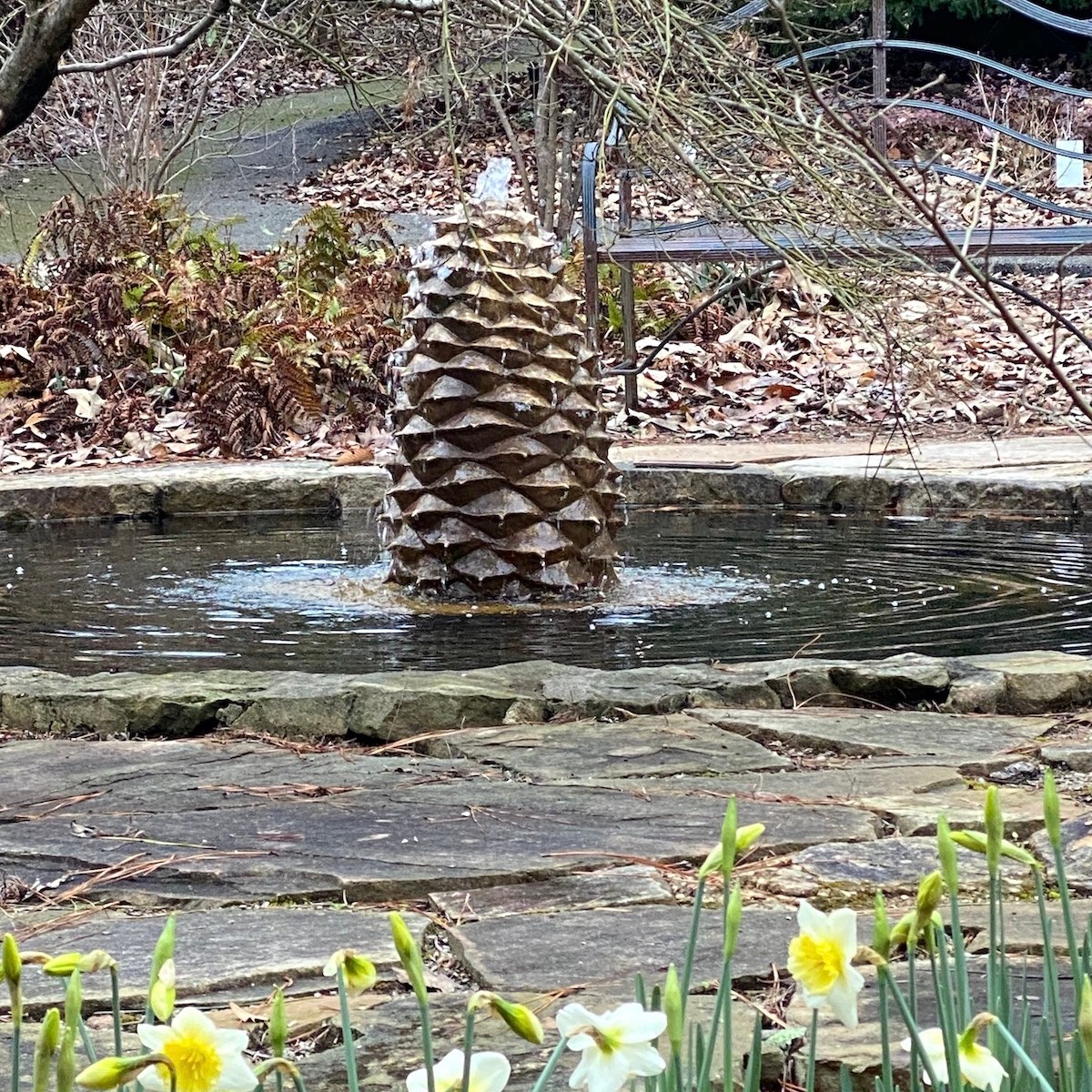
Two Six on Saturday posts in a row! I feel as though I’m on a roll. I’ll begin by noting that the two drought and cold distressed camellias I mentioned last week, ‘Grace Albritton’ and ‘Lady Vansittart Sport’ are now in generous flower, albeit with damaged blooms. But, I’ll take freeze tinged petals over none. No freeze report this week, but there is serious damage.
1. The deer are becoming more numerous in the area and beginning to jump the fence for midnight snacks. They have not touched the copper or maroon colored heuchera, but they seem to like the green. I’m a little anxious about the appetizing green hosta leaves when they grow out.

2. The native columbine or Aquilegia is looking healthy. Based on its orange flowers, I think it is Aquilegia canadensis, but I can’t be certain. It was a “good deal” purchase at a local plant sale a few years ago.

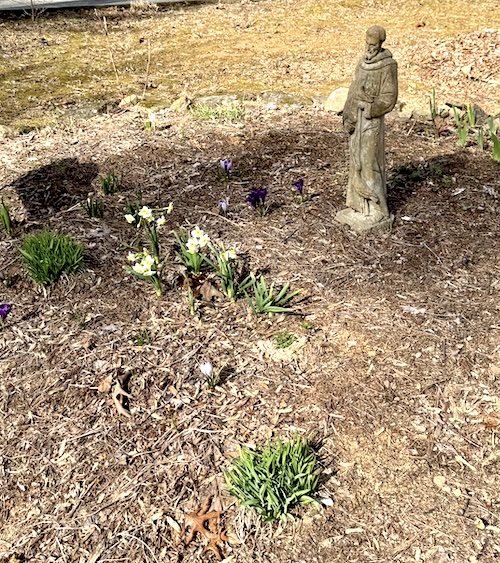
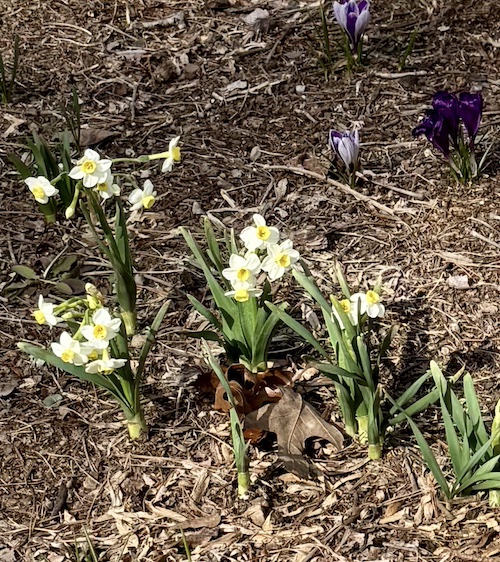
3. The oval garden overseen by St. Francis is beginning to awaken. Purple crocuses are coming up but blend into the soil in the photo on the left. Two healthy looking clusters of Stella D’Oro daylilies are in the forefront. Of special attention, however, is the little patch of of diminutive Bunch-flowered Daffodils (Narcissus tazetta). These were a welcomed give-away at a conference a couple of years ago.
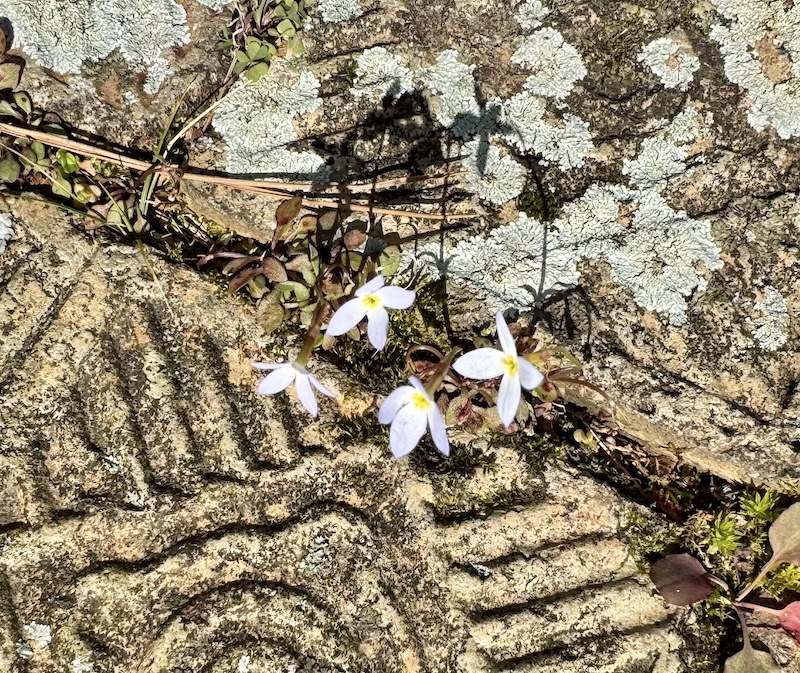
4. Bluets, or Quaker Ladies, (Houstonia caerulea) are typically one of the earliest native wildflowers to appear in the late winter or early spring. So far, these below are the only ones to appear. If my memory can be trusted, this was the first place they appeared last year as well. It is hard, however, to forget these delicate little pale flower springing up between bricks.
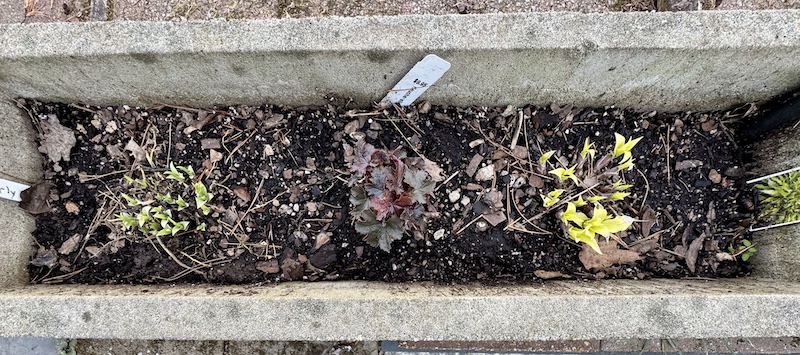
5. Several pots of hostas are showing little plant spikes. I want to highlight two miniatures in the next photo. On the left is ‘Curly Fries’–on the right is ‘Wiggles and Squiggles.’ By late spring their leaves will be long and thin. Fries will have bright green rippled leaves. Wiggles will have bright yellow-green wavy leaves. And, together they will almost completely cover the bronze-toned Huecherella ‘Sweet Tea’ in the middle.
6. My final entry documents a plant phenomenon that has fascinated me since I read Stefano Mancuso’s The Revolutionary Genus of Plants—the biological, hydraulic mechanism of the closing and opening of pinecones. This also explains the featured image at the beginning of this post of the Loblolly pinecone fountain at the Birmingham Botanical Gardens. Last week, I was gathering beautiful, four to five inch prickly pinecones like this one below for sale to Christmas crafters at the upcoming Blount County Master Gardener plant sale.
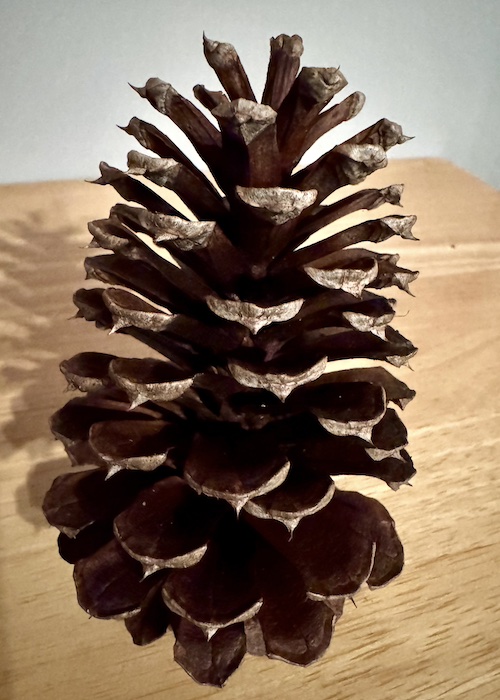
This week, however, there was a period of extended rain, some of it quite heavy. About 10 a.m. this morning when I went to gather more pinecones, although they had been dry, hard, and separated from the tree for months, they were partly closed as you see on the left below. (The mechanism protects the cone’s seeds in bad weather.) By 3 p.m. this afternoon after a sunny, dry day, the same three cones looked like the photo on the right.


Aside from this phenomenon, pinecones are fascinating in historic, religious, and symbolic ways and have been since at least the late Roman and Byzantine eras. Everything from being structured on the Fibonacci sequence (0, 1, 1, 2, 3, 5, 8, 13, 21,…) to representing illumination and rebirth, pinecones are worth a second—or third—look. For a more detailed narrative on the history of the pinecone I invite readers to look back at a post I made two years ago: https://aftereden.blog/2023/02/22/of-pinecones-fountains-and-fascination/.
Any reader looking for more Six on Saturday entries from gardens around the globe can check the links in the comments to Jim Stephens’ Garden Ruminations, the hub of our posts. Guidelines for taking part in this weekly garden sharing can also be found there.
 After Eden
Wow, that’s made me think about pine cones in a way that I never have before. Thanks.
LikeLiked by 1 person
Thanks for the pine cone info – I had no idea! I echo your sentiment on the crocus – I have but one that was here when I moved in. Why not more?
LikeLiked by 1 person
There will be many more crocuses next year! (I hope.)
LikeLike
For one of my classes in college, I needed a batch of Monterey pine seed. That sounds simple enough, but it involved collection of about a grocery bag full of cones, and warming them in an oven. My roommates were not amused. Monterey pine cones can retain their seed until their cones get cooked by a forest fire. More typically, their cones can open when the weather gets warm and dry. Either way, their seed gets tossed while I would not be there to collect it.
LikeLiked by 1 person
Oh gosh, darn deer! We have more of a problem with rabbits here, but I know the pain of varmints eating my plants. 😉 Yes, I agree that pine cones are fascinating…great illustration!
LikeLiked by 1 person
I have a vague recollection of my grandparents having a pine cone in their porch to ‘predict’ the weather!
LikeLiked by 1 person
Fantastic! I love that memory. May I use it in a presentation some time?
LikeLiked by 1 person
Certainly!
LikeLiked by 1 person
Thank you!
LikeLiked by 1 person
Love your pretty St Francis bed! 💞🌼 The opening of pinecones is always fascinating!
LikeLiked by 1 person